|
Home
| What's New?
| Get Started
| Site Map
| The Crash
| Contribute
| Resources
| Disclaimer
| Contact
|
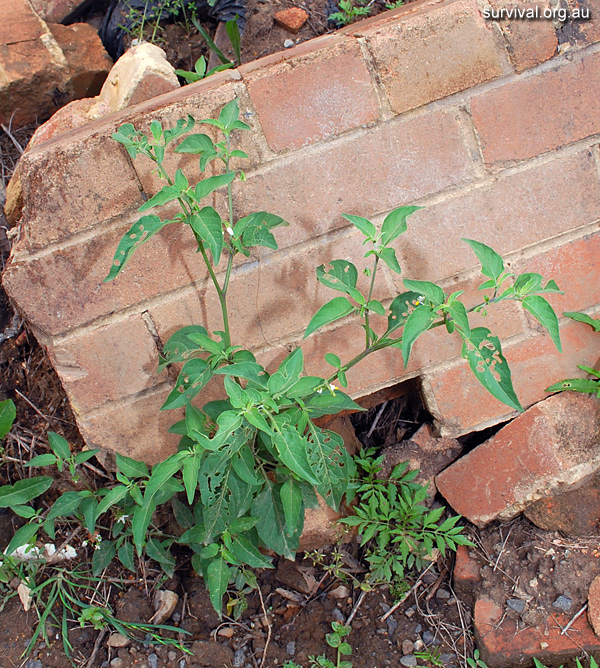
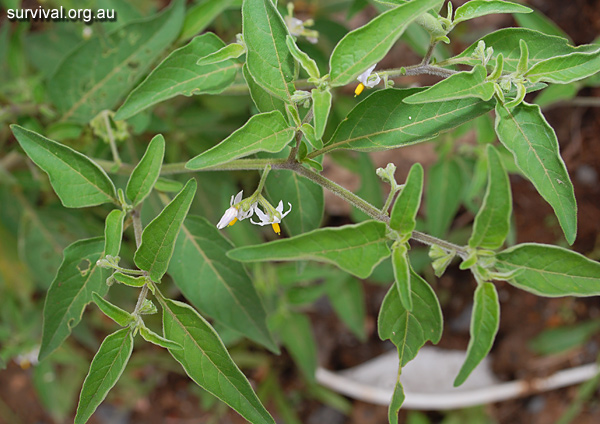
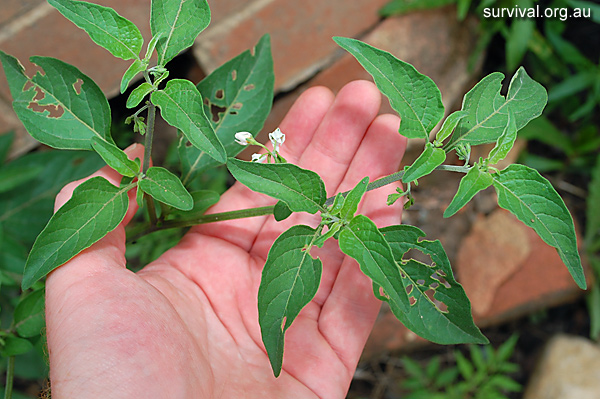
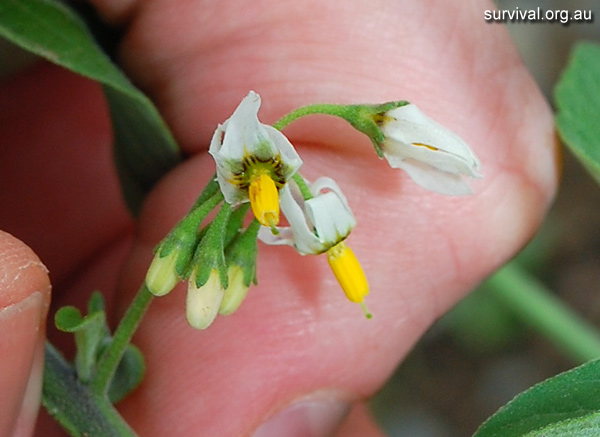
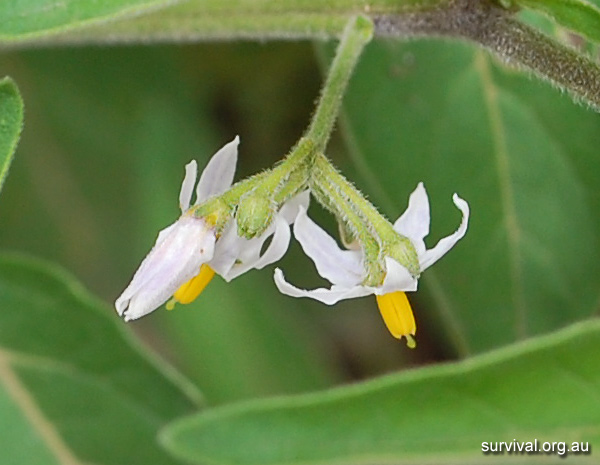
SolanumNightshadesOther names: Kangaroo Apples (this name applies only to certain native species), Wild Tomatoes, Potato Bushes, Tomato Bushes (these names also only apply to certain species). There are about 1500-2000 Solanum species worlwide. Cultivated eggplant and potatoes are Solanum species, and tomatoes used to be before their scientific name was changed. Some native species of Solanum were known as traditional Aboriginal bush tucker plants. Others are introduced edible weeds. Several native species are listed in Wild Food Plants of Australia (though not all of them as edible): Solanum aviculare (Rainforest Kangaroo Apple), Solanum centrale (Desert Raisin), Solanum chippendalei (Bush Tomato), Solanum diversiflorum (Kakarrta), Solanum ellipticum, Solanum esuriale, Solanum laciniatum (Southern Kangaroo Apple), Solanum linearifolium (Mountain Kangaroo Apple), Solanum mauritianum (Wild Tobacco, Tobacco Bush), and Solanum vescum (Gunyang). Of these, Solanum aviculare, Solanum laciniatum, and Solanum mauritanum are the ones that seem to be mentioned the most often (at least in the Southeast of Australia where I live). Rainforest Kangaroo Apple is apparently only barely edible, and not many should be eaten. Solanum mauritianum (Wild Tobacco, Tobacco Bush) is not generally regarded as edible, though it was mentioned as being edible in some volumes of the "Walk Softly with Koa" Bushcraft DVD series, which have since been withdrawn from sale as it is not really edible in large quantities (or at all, some people would say). Tim Low claims that "the berries were eaten by colonists, but are usually too bitter to eat". I have some photos of wild tobacco, I might put them on another page, when I get around to it, not on this page — in case anyone confuses it with the edible Solanum species. According to Wikipedia, "All parts of the Solanum mauritianum plant are poisonous to humans, especially the berries.[2] Human fatalities have resulted from the consumption of the berries.[4] The main toxic compound is the glycoalkaloid, solasodine, with the highest content in the unripe green berry (2% - 3.5% dry weight).[5]". I would not recommend eating this plant. Despite its name, it is not the same tobacco plant that people smoke, they are plants in the Nicotiana genus (which is also in the Solanaceae family... it does get somewhat confusing). I couldn't find any references on the internet to people smoking it, though a couple of people were asking (and no-one seemed to know), and one book said it was not smoked like tobacco. Of the Solanum species which occur in Australia, Solanum americanum, Solanum nigrum, Solanum scabrum and Solanum villosum and Solanum opacum are also considered to be edible (meaning they have some edible parts and some poisnous parts). Solanum chenopodioides (an introduced "edible weed") is listed as having edible berries by Tim Low and several other people. The berries must be ripe (very dark purple/black in colour), and drop easily into your hand (i.e. are almost ready to fall off the plant), otherwise they are very likely to be poisonous. The other parts of Solanum chenopodioides may be poisonous. Solanum americanum (Glossy Nightshade) looks similar to Solanum chenopodioides, though the leaves are generally wider/broader. It is a native of Australia.
Bush Tucker Plant Foods - Edible Weeds australia chenopodioides edible nightshade poisonous solanum species tobacco wild Content is copyright © Survival.org.au 2005-2025 All Rights Reserved. Terms of Use. Definitely read the disclaimer before trying anything from this website, especially including the practices and skills. This website uses affiliate links – this doesn't cost you any more, but I get a commission on purchases made through the website. As an Amazon Associate I earn similarly from qualifying purchases. |
 |
 WARNING: Some species are poisonous (see below) and many species (perhaps all) have some parts that are poisonous, and/or the edible parts are only edible at certain times and poisonous at others. An example of this is green potatoes which are poisonous and should not be eaten. The Solanaceae family includes the famous Deadly Nighshade, Atropa belladonna. As far as I am aware, Deadly Nightshade is not found growing wild in NSW (it's not listed in NSW PlantNet), and I suspect that it doesn't grow wild in Australia at all, though I'm not 100% sure of this.