|
|||
Home
| What's New?
| Get Started
| Site Map
| The Crash
| Contribute
| Resources
| Disclaimer
| Contact
|
|||
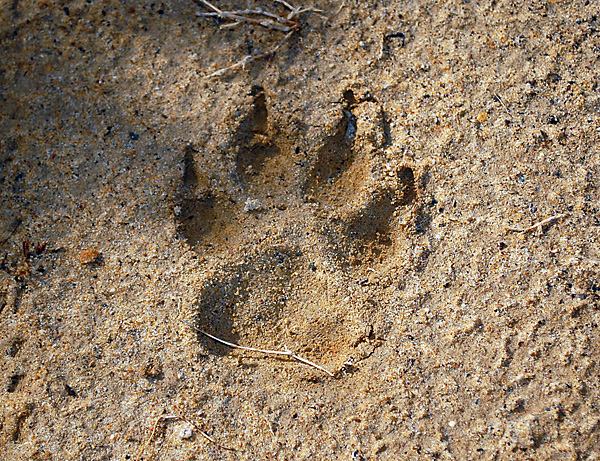
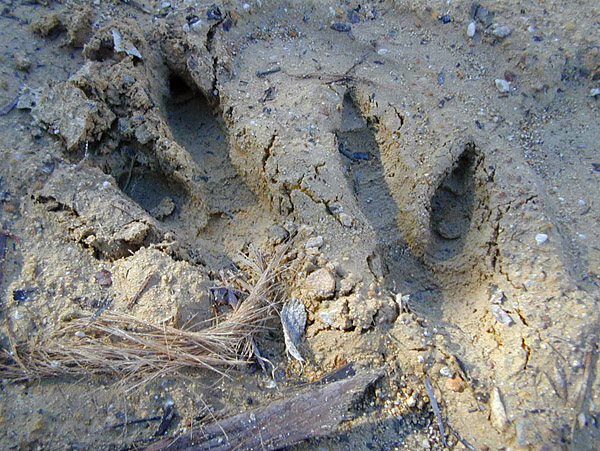
Tracking Animals — How To Read Animal TracksSee also: Animal Tracking Quiz, Make an Instant Tracking Box to Learn Animal Tracking Learning to track is not only a useful wilderness living skill, and a way to learn a lot more about nature and the wilderness — but it is also a great way to slow down, and adopt more of a "wildernes mind". The most basic question of tracking is "What kind of animal made that track?". When you are starting out learning how to track animals, it is a good idea to get a book or a list of what types of tracks are made by what animals. (I will add links later on...) An Animal TrackBefore you scroll down any further, do you know what kind of animal made the track below? The track in the photo looks like a dog track, because it has four toe pads all about the same size, and it also has claws. If I lived in another part of the world, it might also be a coyote (without considering anything else about the track). Or what about a fox, could it be a fox? If I had taken the photo with a ruler (or some other object such as a coin) to indicate the scale of the picture, it would obviously not be a fox since the track is way too large. Another Animal TrackBefore you scroll down any further, do you know what kind of animal made the track below?
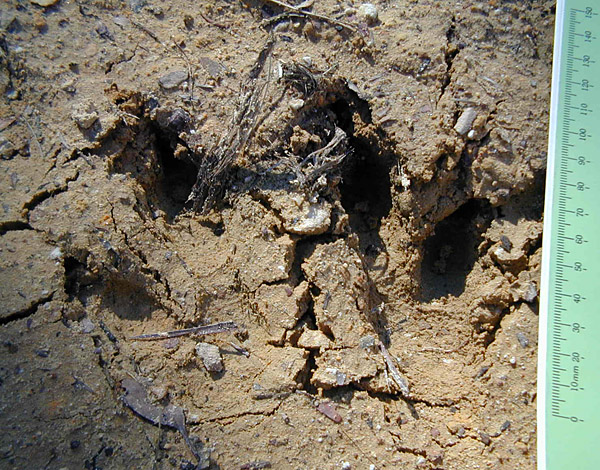
Perhaps having some idea of the scale of the track is a clue...
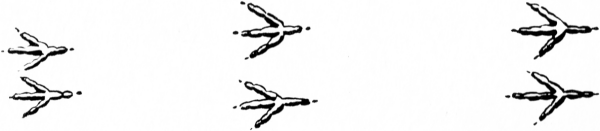
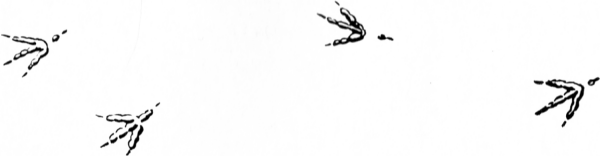
If you are not from Australia, you might have found that one hard. Its not a giant bird, but a macropod (a kangaroo-like animal). From the size of the track and the area that it was taken in, it is a reasonable guess that the track was left by a swamp wallaby. The rest of this page is taken from the 10 Bushcraft Books by Richard Graves. Tracks And Their MeaningThe signs animals leave on the ground can be more revealing than any book written by man, but unfortunately few people are able to see these signs and fewer still can read them. To understand something of the behaviour of animals one must realise that the development of their senses is markedly different to mankind's, and therefore where we obtain information through our eyes and ears, one animal may obtain the same information through its sense of smell and another through its ability to detect temperature changes, or through vibrations. Where man communicates with man through speech, some forms of animal life communicate through telepathy. You see this in a flock of pigeons which turn in flight as one bird. This book broadly deals with some of these special characteristics explaining how knowledge of the 'sensitivity' of the creature is useful, and how the animal's tracks provide a reliable indicator to its habits. The whole area covered in this book, if practised, leads to a remarkable development of one's powers of observation and deduction. Simple deductionTo be a successful trapper you must learn first to observe, and then to make the correct deduction from your observation. For example, if you see a bird move over the ground in a series of hops it would leave tracks like these.
To know that a bird hops on the ground tells you that it is normally unaccustomed to being on the ground. This is turn leads to the conclusion that, being unaccustomed to living on the ground, it therefore does not feed on the ground. Where else then might it feed? Your answer would be that it may find its food either in the air or on shrubs or trees. But you observe that most birds that look for food in trees walk along the branches if they feed on fruit or flower blossoms and that the birds which feed on insects hop from branch to branch. Your final deduction is that birds which leave hopping tracks on the ground are birds which capture their food (in the form of insects) in the air, and so you make a rule, 'hopping birds are insect eaters'. In a general way this is true, but there are exceptions to all these general rules, and not all insect eating birds are hoppers, and not all ground hopping birds are insect eaters. (Consider your pet canary or the lovely painted finches, both of which are ground hopping, and both of which are grain or seed eaters.)
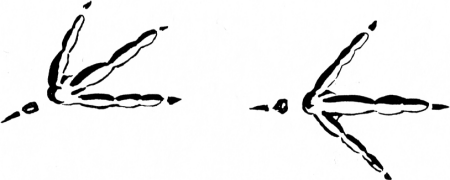
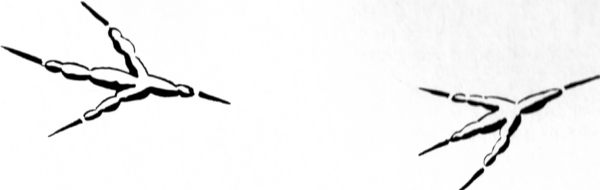
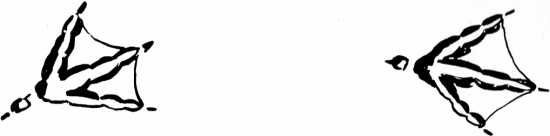
Now consider tracks which look like this. First, these are made by a bird which walks, not hops. Therefore it is accustomed to finding some, or all of its food on the ground. Being a ground feeding bird it may either:
If it feeds on grain or fallen fruit it will not have the centre toe development that would be needed by a bird which had to scratch or dig for its food, nor would it have the rear claw development required by a flesh eater. These, therefore, are the tracks of a ground feeding bird which, not having a digging claw, nor having talons, MUST be a grain or fruit eater.
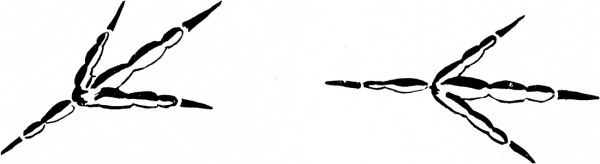
Notice the development of the centre toe, and powerful claw. This is the mark of a ground feeding bird which scratches or digs for its food. It is a ground insect eater.
Here are four short and powerful toes with strong claws particularly on the hind toe. These are the talon feet of a ground feeder which lives on flesh. The foot tracks of a hawk and eagle, or a crow. Naturally the place where the tracks are observed has a bearing on reading the correct answer, and if the tracks are found on the edge of a swamp or marsh the answer could be quite different from the answer if the tracks were observed a long way from water. Tracks read as those of a grain eating ground feeder in forest land could correctly be read, if the same tracks were seen in mud, or by a reedy swamp edge, as tracks of a non-swimming, flesh-eating water bird. Tracks such as these are easily and correctly read.
Animal tracks
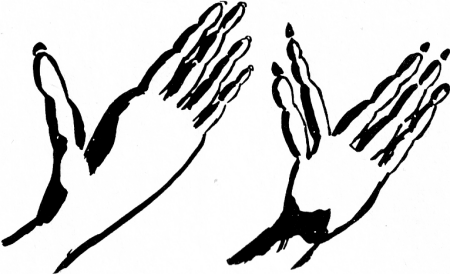
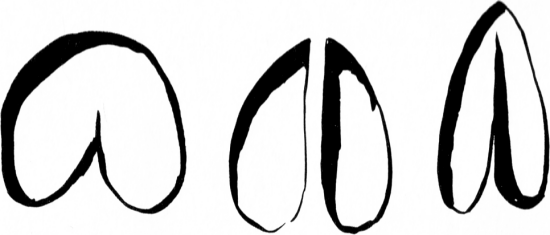
In the animal kingdom the reading of tracks is equally simple. Consider these two - what is the feature you first notice? It is the single or double thumb, the prehensile digit, which is the mark of every true tree climbing animal. Look at your own hand. Can you climb trees? There are exceptions to this, as to the other general rules. For instance the tree climbing kangaroo of North Queensland, which has a prehensile tail. (Incidentally the domestic cat is not a true tree climber. It can 'claw' its way up a tree bill it cannot 'climb', as, say, a monkey climbs.)
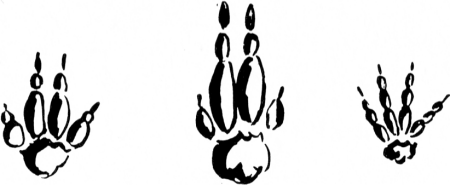
In these tracks the claws of the centre toes are most prominent, and you are correct if your deduction is that these are the tracks of an earth digger, or burrower. The prehensile thumb is undeveloped, you notice. The digging claws may be on fore or hind feet. Generally the fore feet show them most sharply, but whether on front or hind feet, they are the invariable mark of the digger.
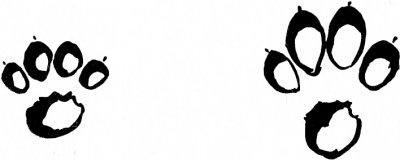
These tracks show neither the prehensile thumb or the digging claw. If you deduce that they are the tracks of flesh eating animals you would be correct, but why? The answer is that the tracks show pronounced 'toes', and that toes, when not used for climbing or digging, both of which call for special development, have another special use in that they give the loot a 'springboard' when running, and so you make the deduction that these are the tracks of fast running animals, and they are not grazing animals because no grazing animal shows 'toes', unless you recognise the hoof of a cow or horse, sheep, etc., as 'tips' of toes or 'toenails', which they really are.
These tracks are made by the grass and herbage eaters. Having neither climbing thumbs, to escape from enemies by climbing, nor digging tools, to escape by burrowing, their only means of escape is by running. Therefore you may decide that animals which have cloven hoofs are very fast running. Tracks indicate habitsTracks made by animals on the ground, when read correctly, show the pattern of the animal's habits. This calls for continuous and careful observation. It is important to recognise the fact that animals, and all living creatures, are as much creatures of habit as human beings. A particular animal will follow the same track to and from water day after day. It will hunt in the same area continually, and only leave the area when driven out by fire, flood or drought. Even then the move is only temporary, and it will return when conditions once again are favourable. This 'habit-forming' characteristic of animals makes it possible for the experienced trapper to predict the animal's movements, and so he selects the sites for his traps or snares, certain that they will be visited. In the bush you will find many animal trails. These are the 'roads' of the bush creatures. They travel over them continually backwards and forwards, to and from their resting places to their feeding grounds and favourite waterholes. By observation of the number and newness of the tracks and droppings on these trails you can gauge the extent of animal traffic. If you put an obstacle across one of these animal trails the animals will make a detour around the obstacle, always following the line of least resistance, and come back to the road again beyond the obstacle. A very good example of these roads are the trails radiating from a meat ants' nest. Exactly the same pattern is repeated in jungle, forest and grassland by all animals. Examine the upward side of a leaning gum tree, and if you see scratch marks of varying ages then the tree is a 'tree road' of possums or koalas, which either live in dead hollows or come to the tree nightly to feed on the young leaves or mistletoe berries. By looking up at a tree you can quickly tell if it is a feeding tree, or a living-quarters-tree. (The latter will show many dead limbs which are hollow, and therefore comfortable living quarters for possums and phalangers.) Recommended Reading
Recommended Listening
See AlsoAnimal Tracking Quiz animal animals australia bird birds feed ground read track tracking tracks tree Content is copyright © Survival.org.au 2005-2025 All Rights Reserved. Terms of Use. Definitely read the disclaimer before trying anything from this website, especially including the practices and skills. This website uses affiliate links – this doesn't cost you any more, but I get a commission on purchases made through the website. As an Amazon Associate I earn similarly from qualifying purchases. |
|||
 |
 NEW
NEW