|
||||||
Home
| What's New?
| Get Started
| Site Map
| The Crash
| Contribute
| Resources
| Disclaimer
| Contact
|
||||||
The Springpole Deadfall TrapThis is the first trap featured in the book "Naked Into the Wilderness - Primitive Wilderness Living & Survival Skills" by John & Geri McPherson. It is described in the book on pages 152 to 158, plus a line drawing at the bottom of page 168. It is also shown on Walter Muma's website. The trap is a deadfall trap, as is the figure four trap, and the Paiute trap, meaning that a heavy weight is set up so that it will fall on the prey animal when the trigger is sprung. The advantage of this trap over the figure four trap, and many other deadfall traps, is that the trigger system is set up independantly to the weight—meaning that it is much easier to set up the weight. The trap can also be used as a trigger for many other situations (other than to let a weight fall as in a deadfall trap), such as to release a snare loop. The trap consists of a long, springy piece of wood (which I will refer to as the spring), three stakes to hammer into the ground, a stick to hold the weight, a shorter stick which functions as the trigger, some cord, and a weight. The spring must be made of old, dead wood, not green, freshly picked wood as this will not have sufficient spring to it. The trap is shown below, with the spring and trigger set but with no weight set. The weight would be supported by the stick that is seen lying down in the bottom left corner of the photo. The trigger is shown just to the right of this stick. When the trigger is disturbed, the spring is released, and moves (up in this picture), pulling the stick out from under the weight, allowing the weight to fall. The spring is held in place at three points—tied at one end with the cord (left of picture), and by the two stakes shown at the upper right and centre. The position of the stakes is such that they hold the spring when it is pulled towards the bottom of the picture. It is helpful to hammer in these two stakes at a slight angle, so that the upper end of the stake slopes slightly towards the spring. This has the effect of pushing the spring towards the ground, holding it firmly in place.
The photo below shows a close-up of the business end of the trap, set up and with a cardboard box used as a weight. In reality you would use a heavy weight, such as a large rock. The trigger is the (almost) vertical stick in the lower centre of the photo with cordage tied to each end of it.
A close-up of the three stakes that are hammered into the ground is shown below. I used the middle stake as the one supporting the trigger piece as the forked part on the left of the stake made it easier to set up the trigger, however this forked part is not essential and is not present (i.e. the end of the stake is straight, like the other two stakes) in the actual book version of the trap.
Recommended Reading
See AlsoOverview of Animal Foods deadfall shown spring stakes survival trap trigger weight wilderness Content is copyright © Survival.org.au 2005-2025 All Rights Reserved. Terms of Use. Definitely read the disclaimer before trying anything from this website, especially including the practices and skills. This website uses affiliate links – this doesn't cost you any more, but I get a commission on purchases made through the website. As an Amazon Associate I earn similarly from qualifying purchases. |
||||||
 |
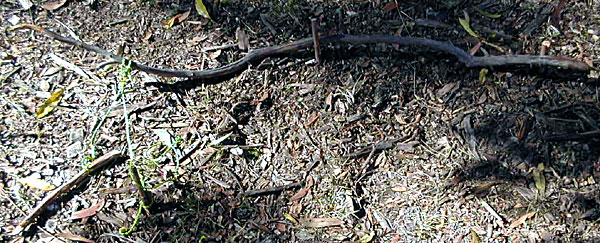 Overview
of the springpole deadfall trap, with trigger set but no weight set
up.
Overview
of the springpole deadfall trap, with trigger set but no weight set
up.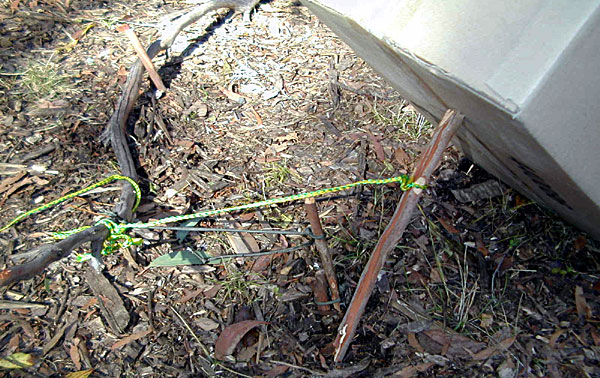 Close-up
of the business end of the trap with cardboard box used as dummy
weight.
Close-up
of the business end of the trap with cardboard box used as dummy
weight.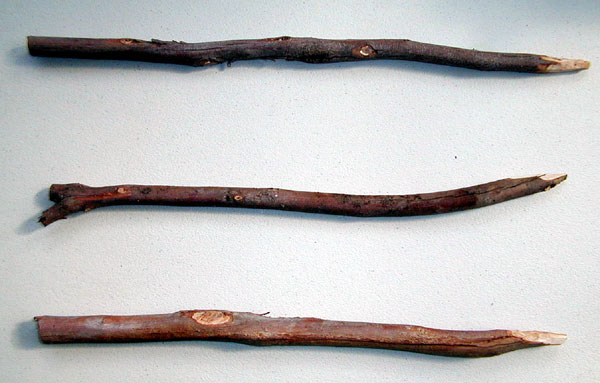 Close-up
of the three stakes that are hammered into the ground.
Close-up
of the three stakes that are hammered into the ground.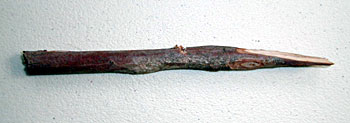 This is a close-up of the trigger piece. It has a flat side
cut into it and a small notch as shown.
This is a close-up of the trigger piece. It has a flat side
cut into it and a small notch as shown.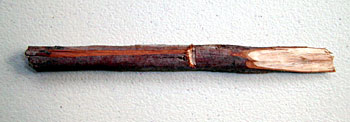 This is the trigger piece shown from a different angle to above.
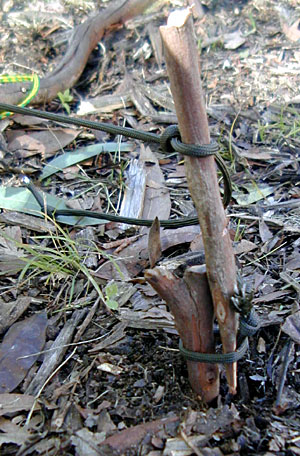 This is the set trigger. It is balanced precariously on the stake
that is hammered into the ground, and held under tension by the
cord at the upper left (which is attached to the moving end
of the spring). Note that the assembled and set trigger does not
itself touch the ground. The loop of cordage at the lower end of
the trigger is not tied tightly. The bait would be placed at the
top of the trigger piece, or in any fashion so that when an animal
nears the trap, the trigger is disturbed.
This is the set trigger. It is balanced precariously on the stake
that is hammered into the ground, and held under tension by the
cord at the upper left (which is attached to the moving end
of the spring). Note that the assembled and set trigger does not
itself touch the ground. The loop of cordage at the lower end of
the trigger is not tied tightly. The bait would be placed at the
top of the trigger piece, or in any fashion so that when an animal
nears the trap, the trigger is disturbed.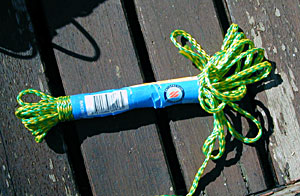 When I first made the springpole deadfall trap, I used this cord, which was very cheap
(maybe $2) from a supermarket. This cord was not very good, because
knots tied in it came undone by themselves very easily.
When I first made the springpole deadfall trap, I used this cord, which was very cheap
(maybe $2) from a supermarket. This cord was not very good, because
knots tied in it came undone by themselves very easily.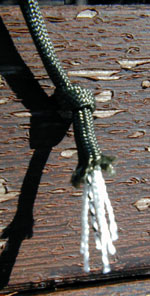 This is "