|
|||||||||||||
Home
| What's New?
| Get Started
| Site Map
| The Crash
| Contribute
| Resources
| Disclaimer
| Contact
|
|||||||||||||
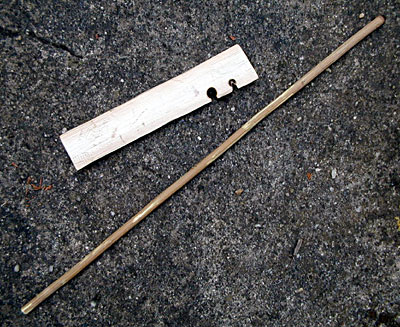
The Hand Drill Fire KitIf you are new to making fire by friction (that is, by rubbing two sticks together), the easiest way to do it is the bow drill fire. For beginners to friction fire, I would recommend starting with the bow drill fire. The hand drill fire is harder to learn than the bow drill, but has the advantage of not requiring cordage, and therefore being easier if you had to start completely from scratch using only naturally occuring materials. The easiest way of all to get started is to purchase a pre-made hand drill firemaking kit, which is what I did. My kit came from Thomas J. Elpel's website and cost US$16. I learned how to use it from the excellent Fire Volume 1 DVD. Firemaking without using modern equipment is a two-step process. The first step is to make a glowing hot ember, or "coal". The second step is to place the coal into a tinder bundle and blow it until you get an actual flame. The hand drill fire requires only two basic parts, the drill, and the fireboard (also called the hearth or base board). It is also very useful to have some kind of flat board (cardboard or wood work fine) to place under the fireboard to catch the wood dust as it forms into a coal. The two pieces in the hand drill firemaking kit are shown below. Note that the thinner end of the drill goes upward, with the fatter, blunter end at the bottom doing the drilling. This will give you more grip as you drill, and more friction. You also need a tinder bundle (see below).
As far as I know, the body position for the hand drill is fairly arbitrary. Most people sit on the ground, cross-legged, with one foot sticking out slightly holding the fireboard down. The hand drill can be hard to learn, so it is best to make it as easy for yourself as possible when you are starting out with it. The first couple of times I made fire with the hand drill kit, I used locking pliers (also known as "vise-grips") to hold the fireboard firmly to the cardboard base board. This way everything was held together firmly, so I did not have to concern myself with the boards slipping around and scattering the wood dust.
You can see all the parts I used for this fire in the picture below. There is a bit of wood dust left over from an earlier attempt at making fire—it's good to keep this so you can place it in the notch next time, and get a fire quicker (as I do further down this page).
Now it is time to start drilling. I haven't got a photo of this yet because there was no-one else at home to take one while I was drilling. You begin slowly, perhaps half a second per complete stroke back and forth with your hands. Pull down with your thumbs hooked through the thumb loops, but not too hard at first. As you drill, wood dust (punk) will fall into the notch, and you will start to see smoke. You need to heat it all up to something like 800 degrees before it will ignite, so take your time here. Keep going until you are getting a consistent stream of smoke at the bottom of the drill. Then go really hard and fast for a bit longer, maybe another 50 strokes up and down, although you may need more. When there has been a lot of smoke, for a while, stop drilling and take the drill away. Blow gently on the pile of wood dust. If it keeps smoking after you have stopped drilling, you have a coal! If it goes out, you need to keep drilling. It is easier in hot, dry weather than in cold, damp weather. Once you get a coal, there is no hurry, it will smoulder away for quite a while before it goes out, so you can take your time.
Recommended Reading
See AlsoOverview of Firemaking bundle coal drill fire firemaking hand hole kit tinder wood Content is copyright © Survival.org.au 2005-2025 All Rights Reserved. Terms of Use. Definitely read the disclaimer before trying anything from this website, especially including the practices and skills. This website uses affiliate links – this doesn't cost you any more, but I get a commission on purchases made through the website. As an Amazon Associate I earn similarly from qualifying purchases. |
|||||||||||||
 |
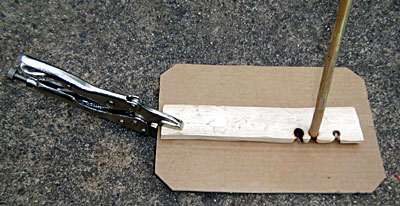 You can use locking pliers to hold the boards together. Today
was the first time I did not use these, I used my foot to hold
the boards down.
You can use locking pliers to hold the boards together. Today
was the first time I did not use these, I used my foot to hold
the boards down.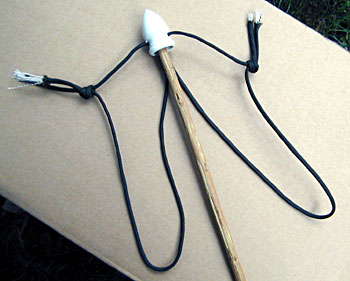 Another aid for beginners (I am still a beginner at hand
drill firemaking) is to use thumb loops. Hook your thumbs into
the loops to pull down on the drill, as you drill. This makes it
a lot easier. The top piece was made from a curtain rod end with
a hold drilled in each side to attach the cord.
Another aid for beginners (I am still a beginner at hand
drill firemaking) is to use thumb loops. Hook your thumbs into
the loops to pull down on the drill, as you drill. This makes it
a lot easier. The top piece was made from a curtain rod end with
a hold drilled in each side to attach the cord.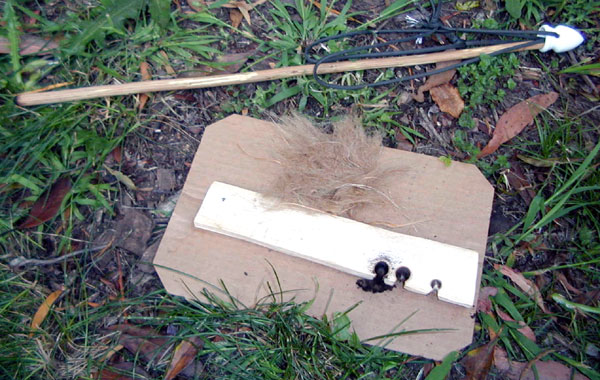
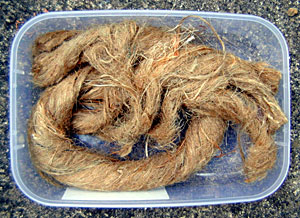
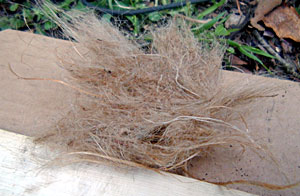 This is a small tinder bundle, made from oakum tinder. Some people
call this a "bird's nest" as it looks a lot like a small bird's nest.
This is a small tinder bundle, made from oakum tinder. Some people
call this a "bird's nest" as it looks a lot like a small bird's nest.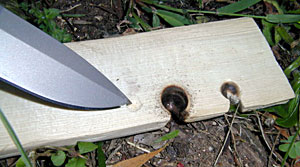 For today's fire I made a new hole in the fireboard. Start with a
knife or other sharp object to make a pilot hole. Rub the drill back
and forth using your palms until you get some smoke and the
hole is a bit charred. You are not trying to get fire
at this stage, just to burn in the hole.
For today's fire I made a new hole in the fireboard. Start with a
knife or other sharp object to make a pilot hole. Rub the drill back
and forth using your palms until you get some smoke and the
hole is a bit charred. You are not trying to get fire
at this stage, just to burn in the hole.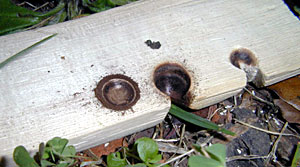 The hole after it has been burned in (the leftmost hole in
the picture).
The hole after it has been burned in (the leftmost hole in
the picture).
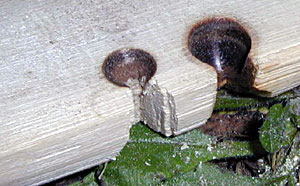 Cut the notch almost
to the centre of the hole (again, the leftmost hole). After the notch
is cut, you are ready to go.
Cut the notch almost
to the centre of the hole (again, the leftmost hole). After the notch
is cut, you are ready to go. 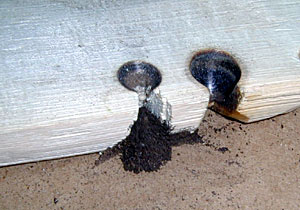 I
had some wood powder left over from a previous attempt. I put that
in the notch because the coal forms faster if there is already some
powder there. The proper term for the wood
powder is "punk".
I
had some wood powder left over from a previous attempt. I put that
in the notch because the coal forms faster if there is already some
powder there. The proper term for the wood
powder is "punk".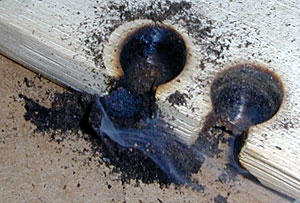 Here is the smouldering ember, or "coal", which has formed from
wood powder and got hot enough to stay lit. Blow gently on the
coal to make it spread, then let it rest for a few-several seconds.
Do that a few times until the coal has spread almost right through
the pile of wood dust.
Here is the smouldering ember, or "coal", which has formed from
wood powder and got hot enough to stay lit. Blow gently on the
coal to make it spread, then let it rest for a few-several seconds.
Do that a few times until the coal has spread almost right through
the pile of wood dust. 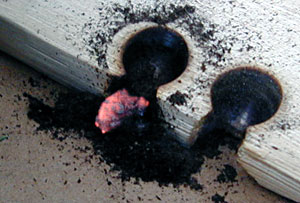 The glowing coal in the notch. I was gently blowing on the
coal to make it glow more as I took the photo, and I turned off the
camera's flash. Then you carefully lift the
fireboard away, and transfer the coal (a small stick is helpful)
into the tinder bundle.
The glowing coal in the notch. I was gently blowing on the
coal to make it glow more as I took the photo, and I turned off the
camera's flash. Then you carefully lift the
fireboard away, and transfer the coal (a small stick is helpful)
into the tinder bundle.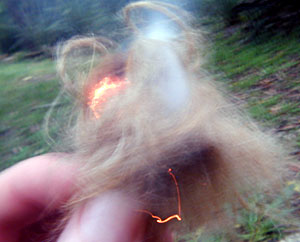 Wrap the coal up inside the tinder bundle. Hold the tinder bundle
between your fingers, alternately blowing air through it and
then letting it rest for a few-several seconds.
Wrap the coal up inside the tinder bundle. Hold the tinder bundle
between your fingers, alternately blowing air through it and
then letting it rest for a few-several seconds.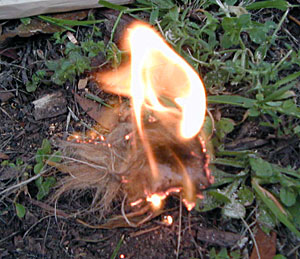 The tinder bundle should suddenly burst into flame (be careful of
your fingers), and now you have fire!
The tinder bundle should suddenly burst into flame (be careful of
your fingers), and now you have fire!
 NEW
NEW