|
|
Home
| What's New?
| Get Started
| Site Map
| The Crash
| Contribute
| Resources
| Disclaimer
| Contact
|
|
How to Get StartedSee also: Why would I want to learn sustainable living and wilderness survival skills? NOTE: If you are looking for the first information to learn on how to survive if you are lost in the wilderness, see Survival Essentials: How To Survive In The Wilderness. NOTE ALSO: If you are looking for how to get started with what to do when the global economy crashes (or if you live in one of the countries where the economy has crashed already), see What To Do About the Upcoming Economic Crash. The best way to get started is to find something that you are genuinely interested in, and focus on that at first. As you do that, you will find yourself becoming interested in other things that are related, and then you will probably want to learn about those too. What Kinds of Things?Pick just one thing (or at most a couple of things) from the list below that you like the idea of learning about — especially about how to do it without relying on much in the way of modern, fossil-fuel-based technology. Then continue on with the rest of this page after the list. If you don't find anything that you feel interested in, go to the Inspiration Section of the website and have a browse through what you find there. If you find something there that grabs your attention, come back to this page.
Actually Doing StuffThe main idea is to be actually doing stuff, on a regular and consistent basis. And within a narrow enough area so as to eventually become proficient in what you are doing - but not so narrow as to become bored or disinterested, or to feel that what you are learning is trivial and insignificant. Determining what actual tasks will satisfy these requirements will no doubt be a matter of some trial and error, and fine tuning of the list of individual tasks/goals/expectations, and this will be done as I go. To start with, I will focus on the four areas of fire, cordage, plant foods and animal foods, and see how much I can actually do in these areas. Regular, consistent practice, just a little at a time, is the number one mandate. I am thinking something like 30 minutes, perhaps one hour, a few days a week, more if I feel like it at the time. Even as little as 10 minutes a day, even 30 minutes a week—of actual practice—can bring much more benefit than you may at first think. Of course, if you are thinking of actually trying this yourself, the time you spend will depend on your own level of interest and your other commitments. The key idea is to be actually doing real, practical things, on a regular basis. Tools and EquipmentThe beauty of "self-sufficiency" is that you just do not need a lot of stuff. Ultimately, the goal is to be able to do a whole lot of things with almost no stuff at all. That is, most (or even all) of the raw materials will come from nature, in your local environment. However, to begin with, it will be easier to learn the skills with the aid of some simple tools and equipment. How far you may wish to take this is up to you, I will describe what I am using and you could use that as an example to get you started.
For the gardening/permacultre section you would need some basic garden tools, which I will write more about elsewhere. Here too there are really not that many things that you need to get started with. From left to right: metal match with plastic file handle (see fire section), old "bread and butter" knife, 3/4 inch chisel, pocketknife, Swiss army knife. If I was buying a chisel just for this kind of work, I would probably get a wider one, perhaps 1 inch. The pocketknife cost about $30 from a disposals store, and has a locking blade, which is a very useful feature. A non-locking blade on a folding knife can close on you while you are using it, the sharp edge of the blade will then be aimed at your fingers. I have a couple of small scars on my right index finger from this happening to me when I was about 10 years old. The Swiss army knife has a saw blade, which is very useful. If I was buying a new swiss army knife, I would get one with both a saw blade and a locking knife blade (mine has a non-locking blade). You Don't Need to Go AnywhereYou can practice a lot of skills at home, without going anywhere. You don't need to own acres in the country, or live right next to native bushland. The learning and practice of most primitive skills can
be done in your backyard, garage, basement, even living room (depending
on the
wife or husband). You CAN become proficient in them without ever
venturing beyond these bounds. And in ever in a primitive situation,
either by choice or chance, though you will feel that the application
is not as easy as your backyard, you will still have the understanding
and "feel" of the basic functions, the confidence that
you know how to apply the various methods and you will own that special
feeling
of freedom that comes from knowing that you need depend on no other
man. Reading about survival skills is never enough. The
mastery of any art comes only through practice. Don't wait for a
crisis to begin developing your survival skills. Start right in your
own living room or basement, using materials found in local parks
or your own backyard. Each skill mastered will add to your reservoir
of confidence, making your emotional and mental adjustments much
easier in a real survival situation..... Practice whenever you
can. The Hardest PartWith any new activity, often the most difficult thing is knowing where to begin. (That is why I have made this whole website, to give ideas on where and how to begin). And just to actually begin. Also, I have found that what I am doing can feel very insignificant, when you start to actually do things. You realise how little you really know, and you think about how much more others know. It is very easy to feel like an idiot. I have found that the most likely time to give up on something is when I don't know what to do next. So, to prevent this, always have a list of two or three things to do next. Or five things, or ten - try and always have something that you can go on with, that is clearly defined, so that you are never in a position where you can't think of anything to practice on any given day. I have found that if you have a few different things that you could work on, you are much less likely to ge bored. When you feel that you are stuck on something, there are days when you feel like just making it work, whatever it takes, and days when you really couldn't be bothered. If you have a few different tasks lined up, some easy, and some that you may be stuck on, the idea is that you will always have something to work on, that you feel like working on. So do not feel despondent if
you feel as if you do not know where to go from here. In not knowing,
you have already taken the first
step in the right direction—you have opened yourself to finding
out, to learning. In being open you cannot help but to learn, and
every new insight, every new bit of experience gained, will lead
you one step further, and that step in its turn will reveal the next
step, and so on. Just start. How you start is not
important. And above all, remember that understanding is only for
fools who are
too lazy to want to learn. Understanding means the ability to grasp
information imparted. But it is not information you are needing here.
It is knowledge you need, and knowledge can only be gained through
practical experience. How to Really Get StartedIf you are serious about this, write down a few (say two to five) things that you could actually do, that you could start as soon as you stop reading this website. Or maybe later today, or within a few days, depending on your own schedule. The important thing is to have a small number of tasks on hand, and to actually do something towards them, and to do it now, today, or relatively soon. What kinds of tasks? What I did was to break things down into my four chosen areas of fire, cordage, plant foods and animal foods. You could pick other areas, these are just what I think are the most important to learn first, and what I will be writing the most about on this website. I got four blank A4 pieces of paper, one for each area, and wrote the heading at the top. Then I thought about what small, individual things I could do to gain some practice in each area, that would allow me to gradually make progress with my level of skill. To begin with, you will need some information, before you can actually practice the skills. So, the first thing to write on your task list would be something like, "Look for where to find information on making fire without modern tools", or, "Look for where to find information on plant foods/bush tucker". You can (when I add them to the website, that is....) see examples of my own beginning lists on the site map page. Finding a Secret Spot
|
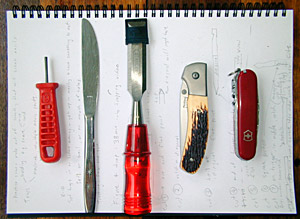 Here
are
the tools with which I began this website, learning survival skills and making things. As you can see there
are not many.
Here
are
the tools with which I began this website, learning survival skills and making things. As you can see there
are not many.  NEW
NEW|
All of the information on this website is offered with the assumption that you and others will exercise proper caution and care in doing any of the things that are presented on this site. YOU, and ONLY YOU, are responsible for the use to which you put this material. Some activities related to wilderness survival and self sufficiency can be dangerous if done without proper care and attention. Please be careful and attentive when engaging in any of these activities. Use common sense. Take proper precautions. Some of the techniques shown on this website are meant solely for use in wilderness survival situations. Please note that in most places it is illegal to use these methods to capture animals unless you are actually in a survival situation. It is similarly illegal to "harvest" or otherwise disturb native plants in many locations, including within the boundaries of national parks.
|
blade feel food information learn learning own practice skills start started survival tools website wilderness
Content is copyright © Survival.org.au 2005-2025 All Rights Reserved. Terms of Use. Definitely read the disclaimer before trying anything from this website, especially including the practices and skills. This website uses affiliate links – this doesn't cost you any more, but I get a commission on purchases made through the website. As an Amazon Associate I earn similarly from qualifying purchases.