|
||||||||||||||||||||||||||
Home
| What's New?
| Get Started
| Site Map
| The Crash
| Contribute
| Resources
| Disclaimer
| Contact
|
||||||||||||||||||||||||||
Make an Instant Tracking Box to Learn Animal TrackingSee also: Animal Tracking Quiz, Tracking Animals – How To Read Animal Tracks This page shows how to set up a very quick, cheap, and easy tracking box, which you can use to learn a huge amount about animal tracking. This "clamshell" method is the easiest way I could think of to make a very cheap, quick, and easy tracking box. Most of Australia's mammals are nocturnal. This method is an excellent way you can see the tracks and traces left by the animals that we don't normally see — including animals that you may not even know you have living close to you, who visit your backyard regularly at night. The Easiest-to-Make Tracking Box I Could Think OfThis is the easiest way I could think of to make a tracking box. Before I thought of this clamshell children's sandpit/wading pool, I thought of a large-ish rectangular flat storage tray. Like the ones you can buy from "$2 shops" for about $10. However they are much smaller in terms of surface area of sand (after you fill the tracking box with sand, to record animal tracks) than the clamshell tracking box as shown here.
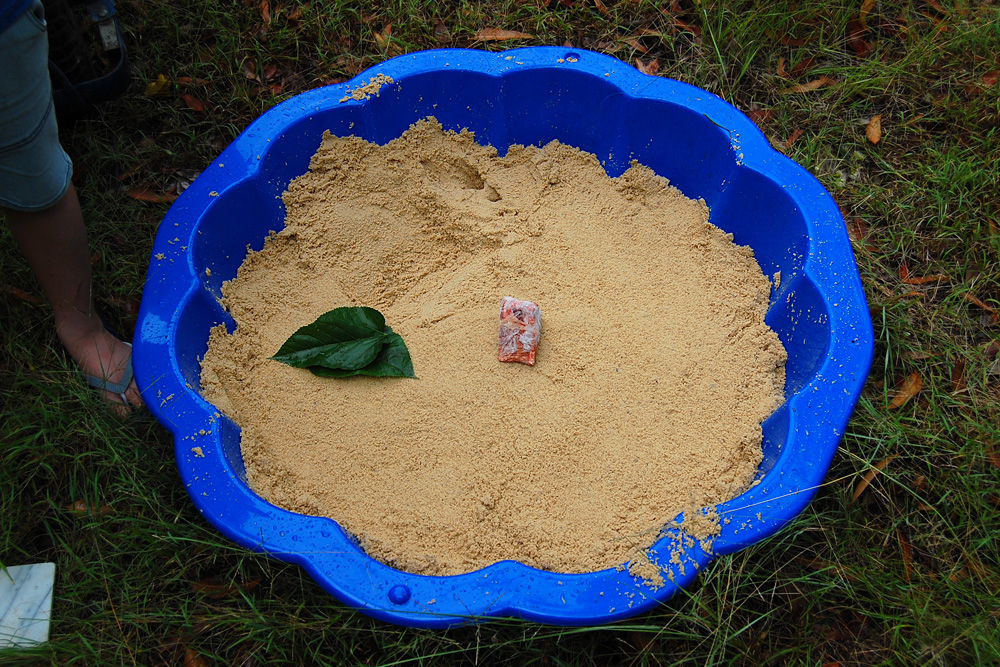
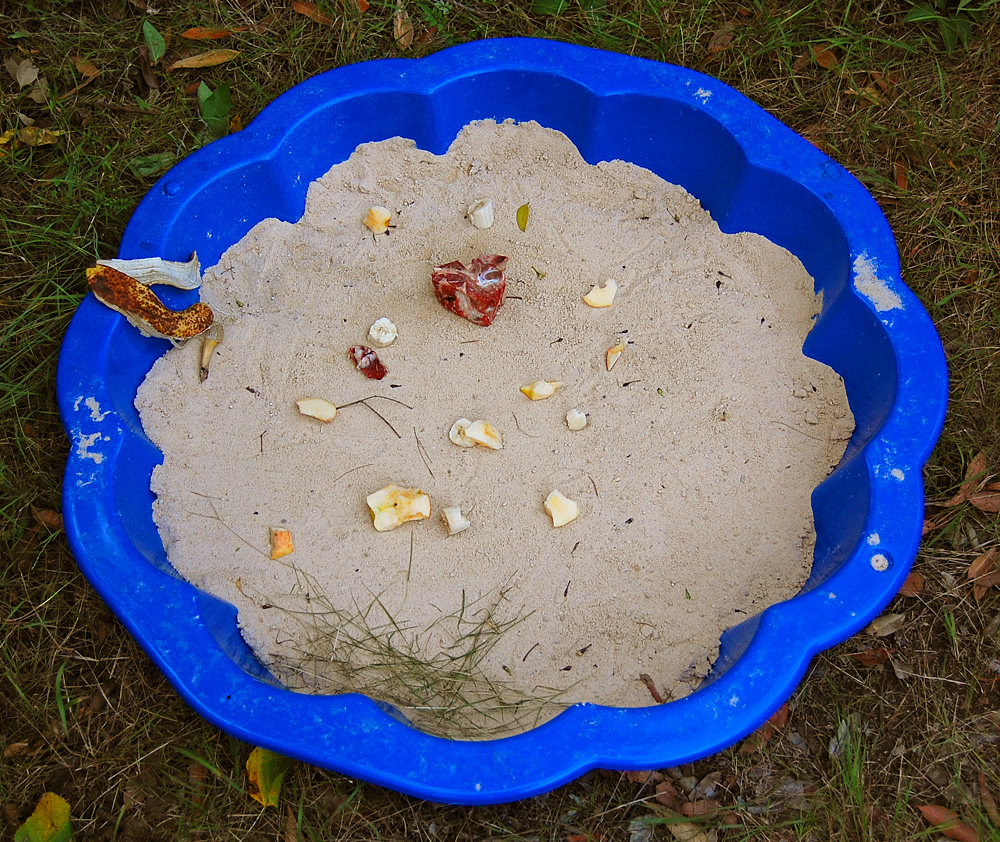
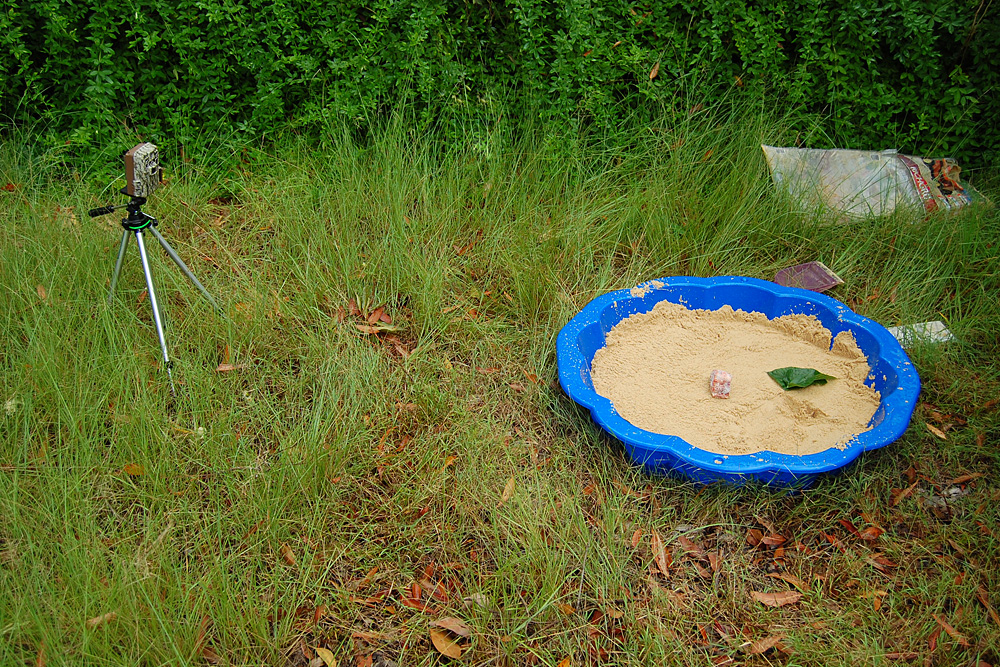
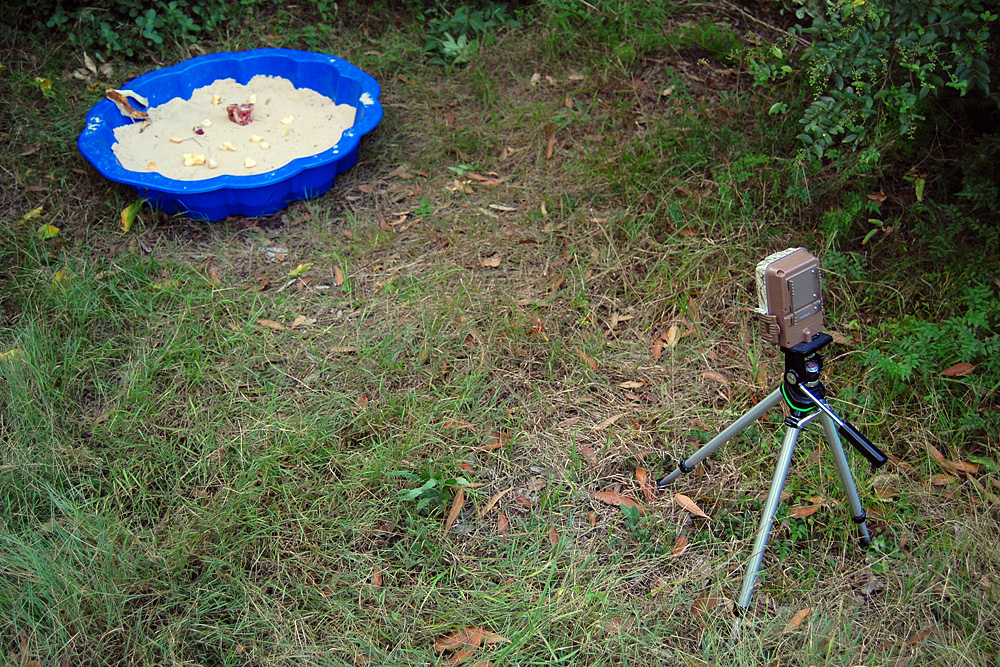
Above you can see the tracking box ready to go, complete with bait — which is pet grade meat that I bought fresh for $2.99 a kilo, and then froze. It will thaw out overnight. My son added the mulberry leaves in case silkworms also came to eat them, so then we could see the silkworm tracks left in the sand too. Ingredients required
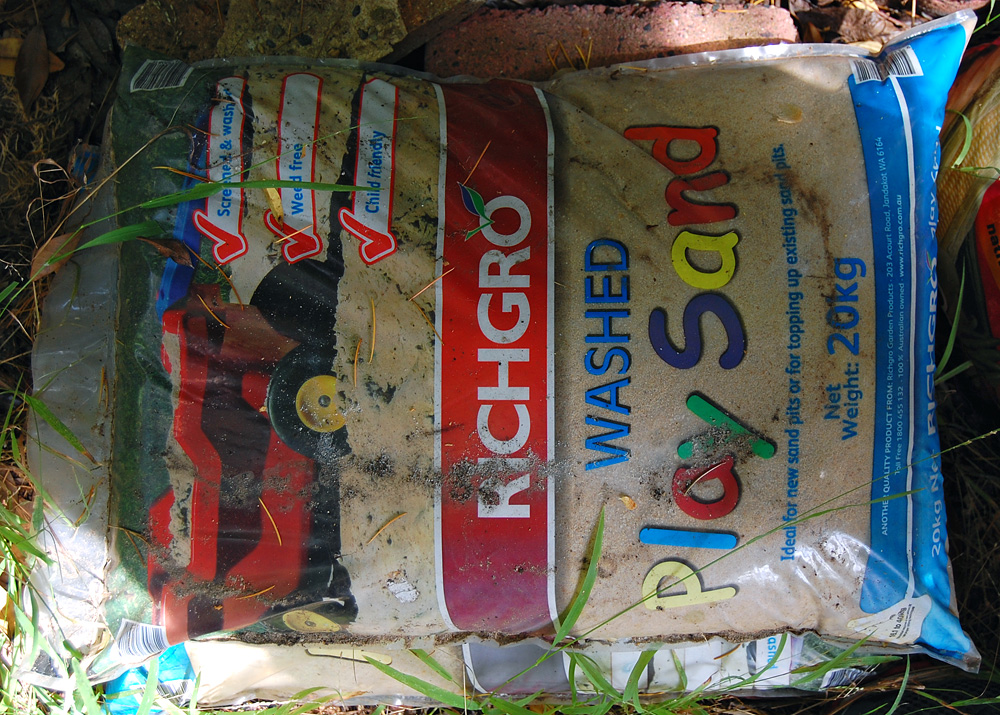
Of course this could be a larger and more elaborate sandpit, which would be better (because it would be bigger). The book "The Science and Art of Tracking" by Tom Brown, Jr. shows how to build one just for using as a tracking box (though it could also be used as a children's sandpit too). Or you can just buy one of these very cheap "clam shell" ones. These are extremely cheap (I forget, but I think it cost about $25 in total for both the upper and lower halves of this one, which may have been a discounted price after the Christmas retail frenzy was over).
What Can You Learn About Animal Tracking from a Tracking Box?Some of the things you can learn from a tracking box include seeing the footprints and what they look like, seeing them in different levels of dryness of sand, seeing how the footprints age over time, seeing what animal tracks you get (there may be surprises), seeing what animals eat what baits (I didn't know possums were interested in meat until I put out some and secretly caught them eating it on trail camera), seeing how the tracks look from different angles in real life (as opposed to idealised ones in a book), and more...
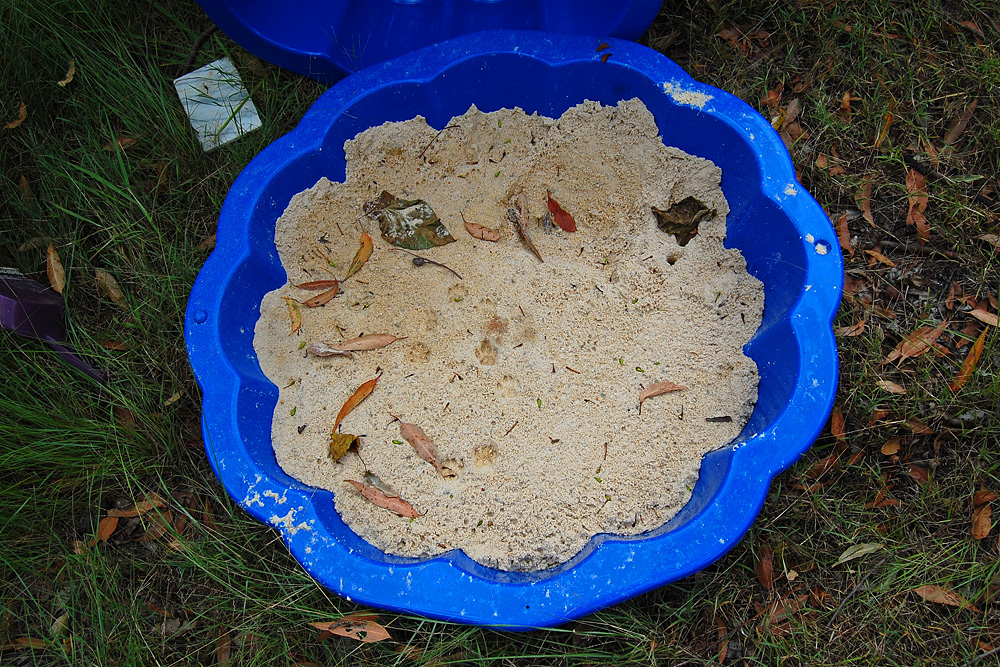
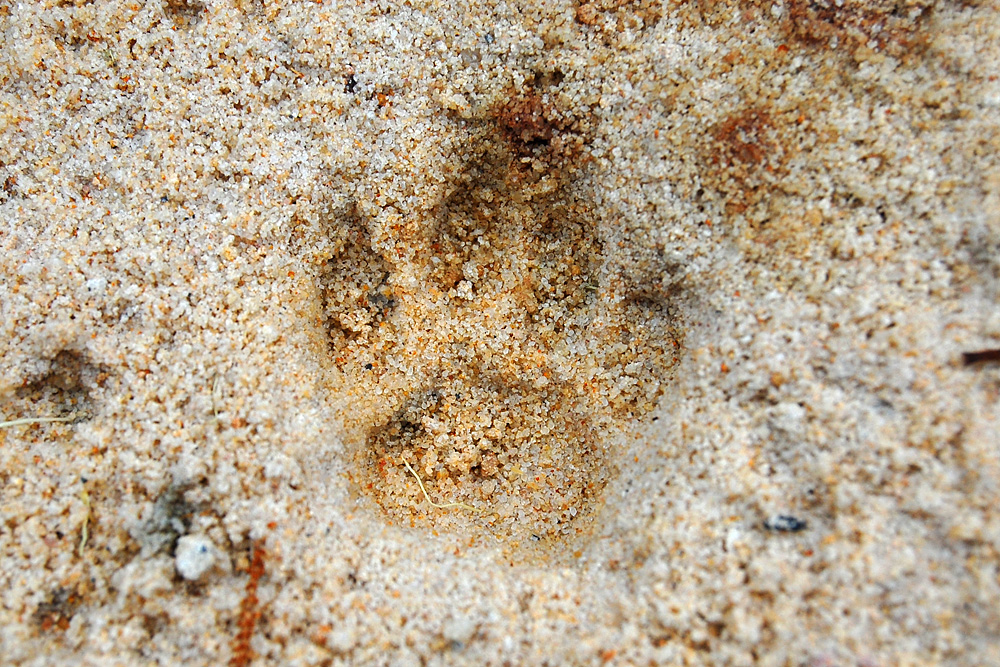
Above you can see the tracking box after the first time I left it out? What kind of animal left these tracks? (Photos below will show the answers). Most of the human societies renowned for their tracking skills lived in sandy areas (e.g. the Aborigines of the Australian deserts, the San of the Kalahari, and others). Having access to areas of sand, or some other ground material that leaves good imprints of animal tracks is a vast advantage in learning animal tracking. Most of Australia's modern residents do not live in (or very close to) large expanses of sandy ground. Yet, even having regular access to small areas of sandy ground is a massive advantage to learn animal tracking. For most households probably the easiest way to do this is to use a children's sandpit.
Second Time Setting Up the Tracking BoxThis is the second setup of the clam-shell sandpit tracking box. Some fruit was added along with the same type of cheap pet-grade meat as used before.
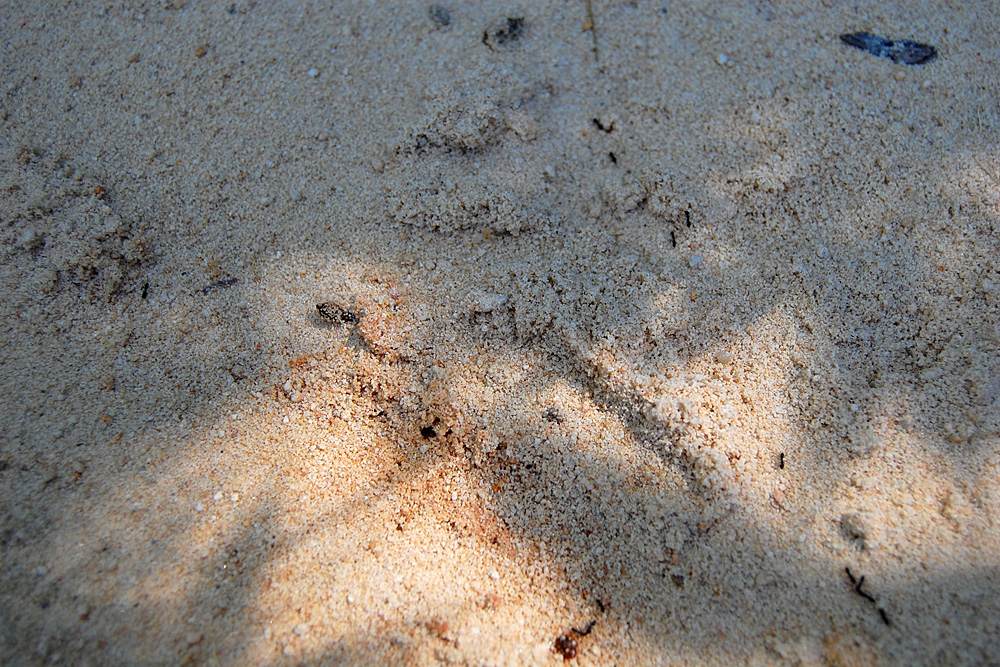
This is a photo from the second setup of the tracking box (as is shown above) after leaving it overnight. Can you see any tracks?
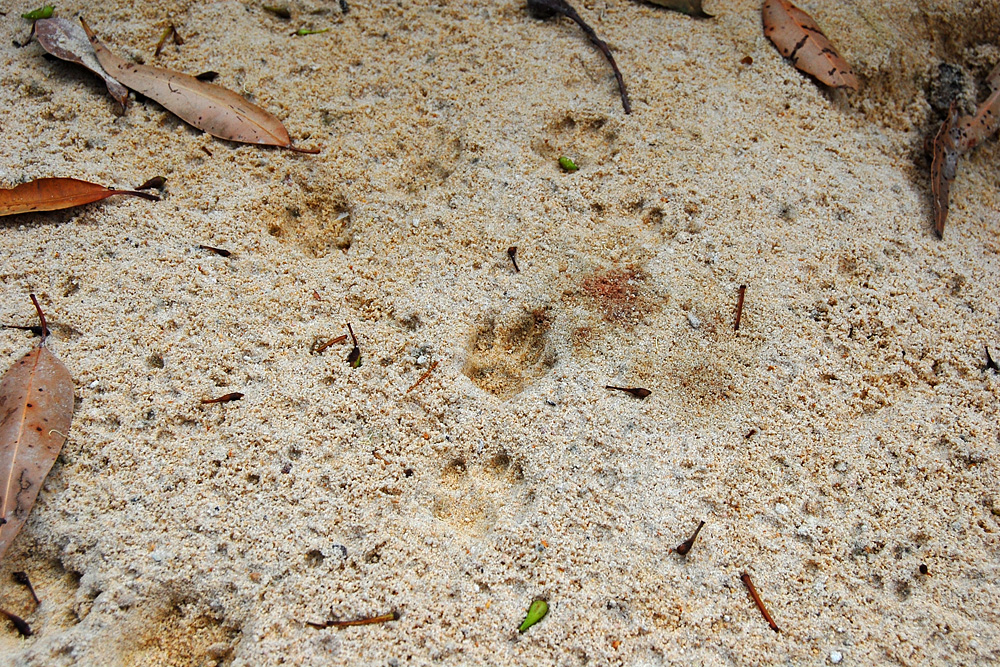
This is a close-up crop from the same photograph as shown above. The tracks are a bit easier to see here, but still not super-obvious.
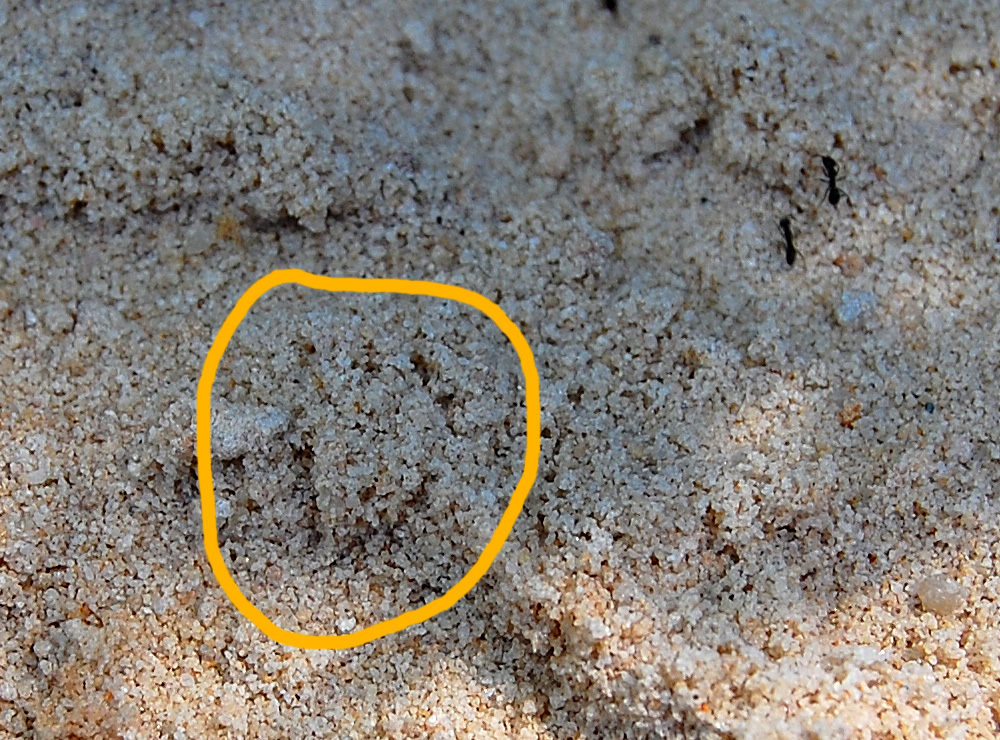
In case you're having difficulty seeing any tracks in these photos, here is one highlighted in orange. What animal do you think could have made these tracks?
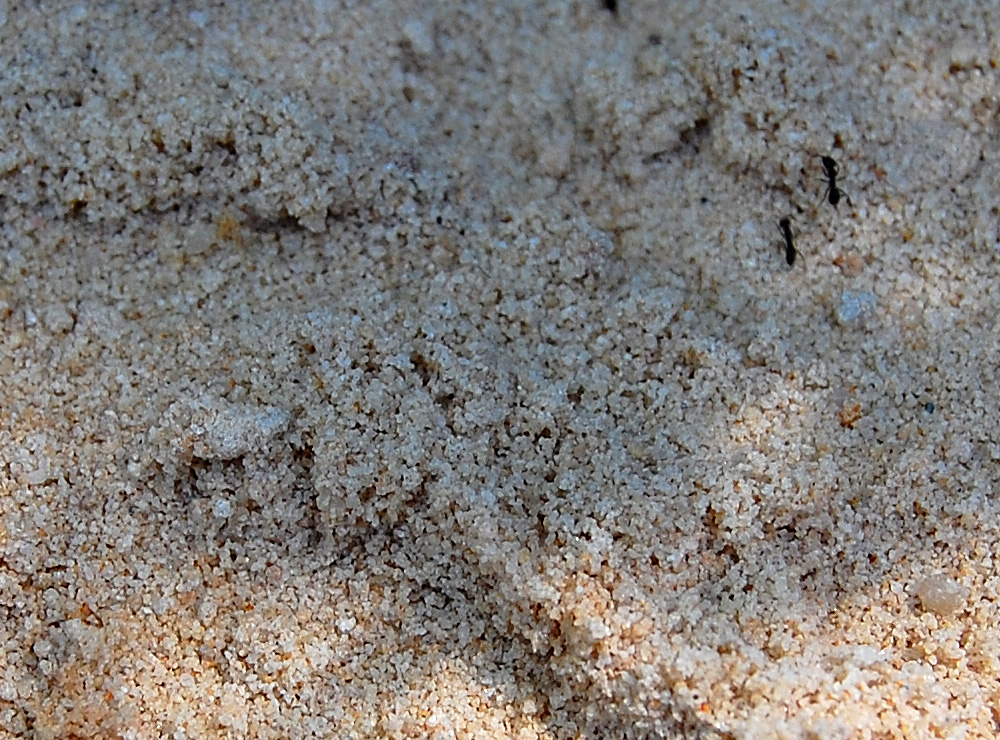
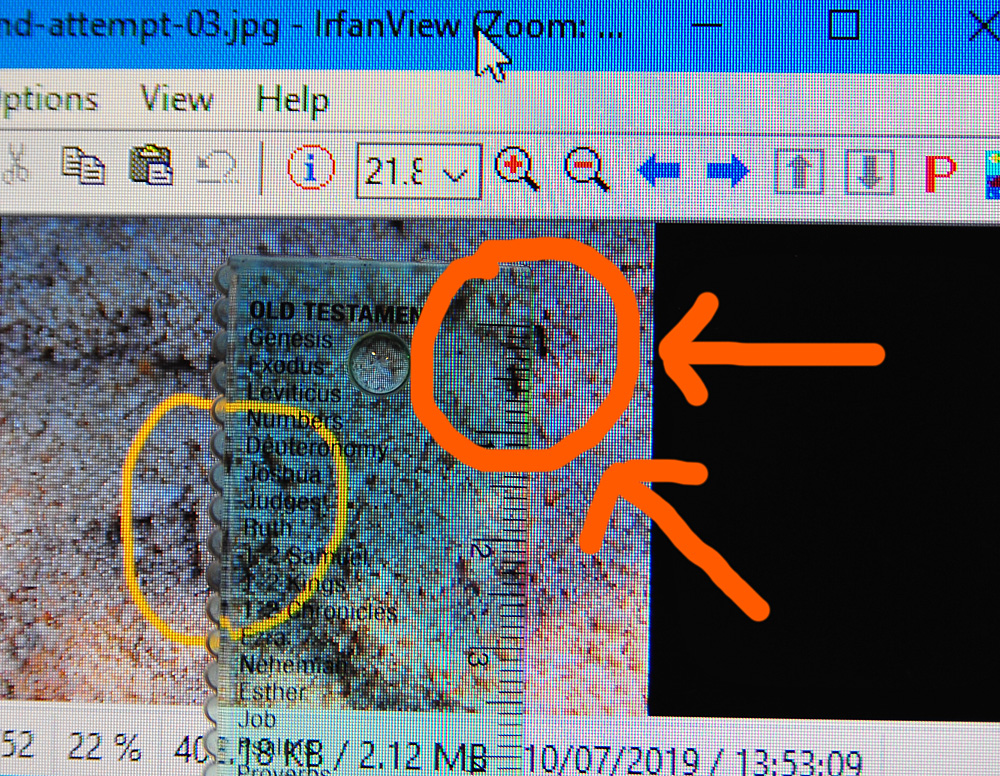
Measuring the Animal Track Sizes from Your PhotographsYou can use some basic data analysis techniques to more accurately determine the sizes of the animal tracks you find. This could also be done in real life of course, by measuring the track on the sand itself. Which would be much easier — assuming I'd thought to do that at the time. Now, I only have the photographs. I looked up the size of the common black house ant online and it says 2.5 to 3 mm in body length. Then I adjusted the zoom of the track photo so that the ants as seen on my computer screen were exactly that size, using a ruler to measure them:
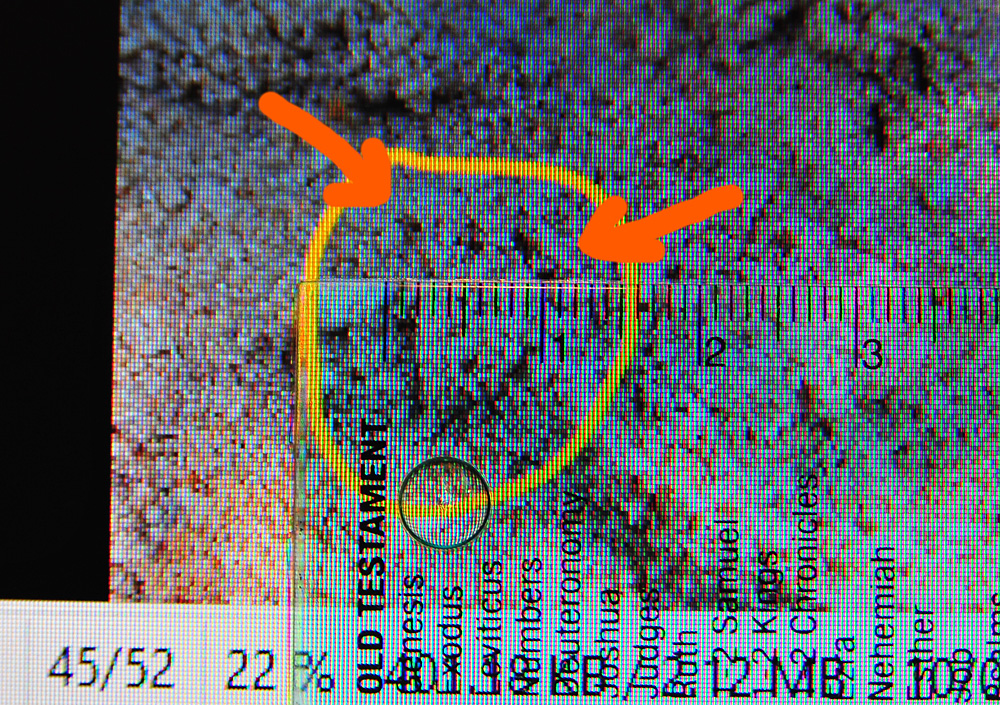
Next, with the same image on the screen (at the same zoom setting, I measured the size of the unknown animal track in the photo, that left the claw marks in the sand:
Which indicates that the foot size of the unknown animal is quite close to one centimetre, since that is the size across the spread of the claw marks that it left in the sand. What animal would frequent my garden that has claw marks that look like that? Using a Trail Camera With the Tracking BoxIf you have (or can borrow) a trail camera you can use that with the tracking box to see exactly what animals have made the tracks. This is the setup we used for our first try at using the tracking box, as pictured at the top of this web page:
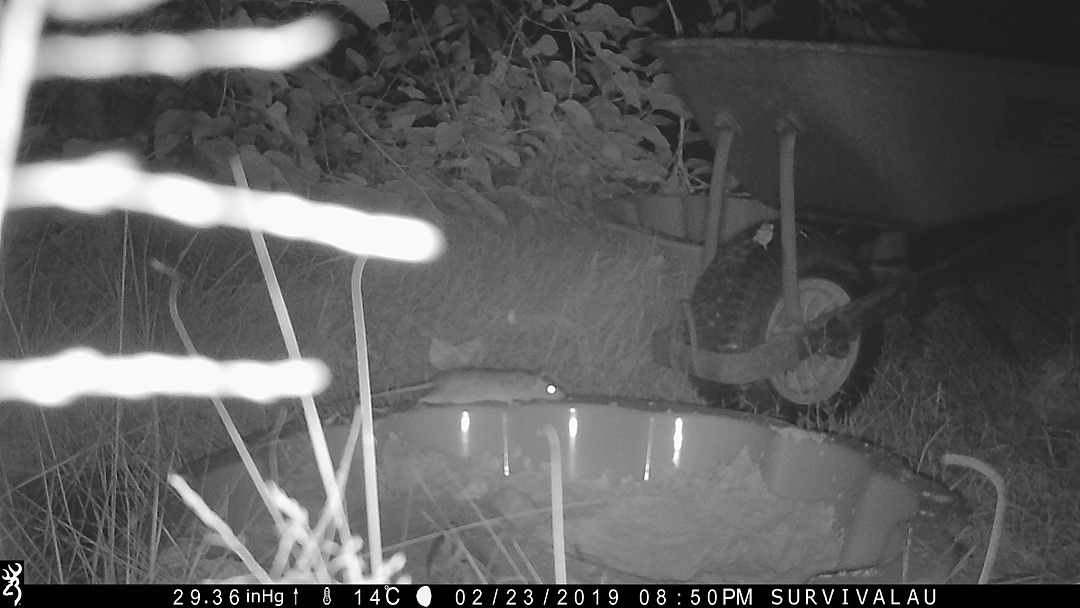
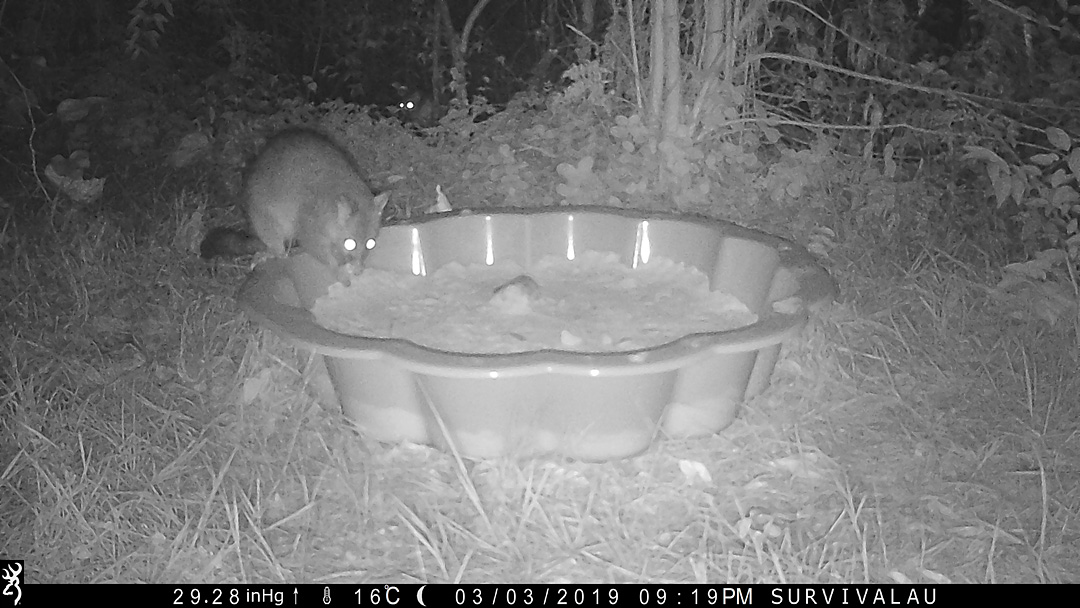
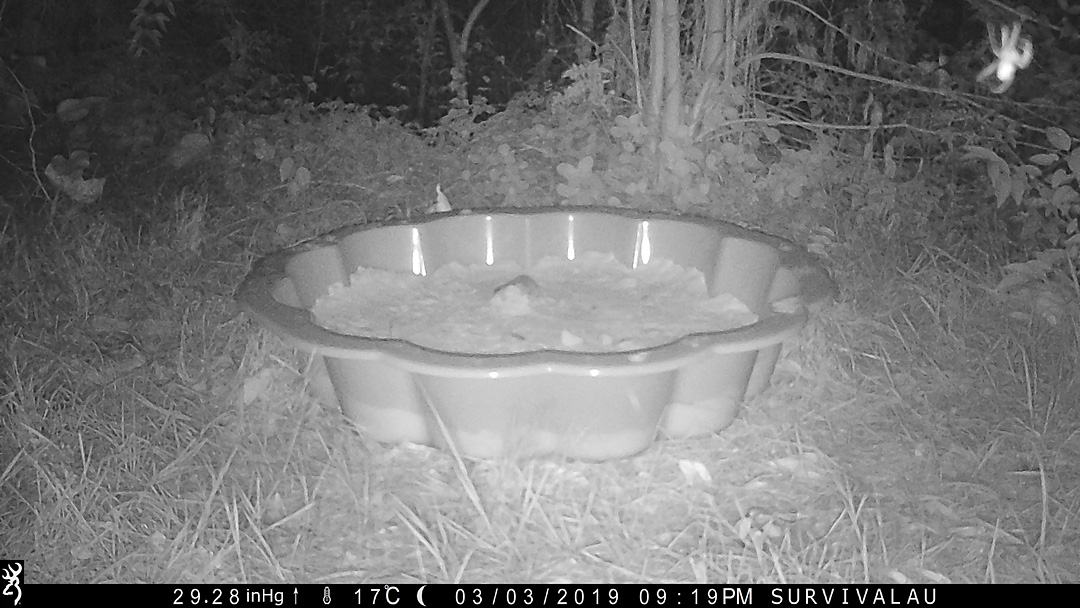
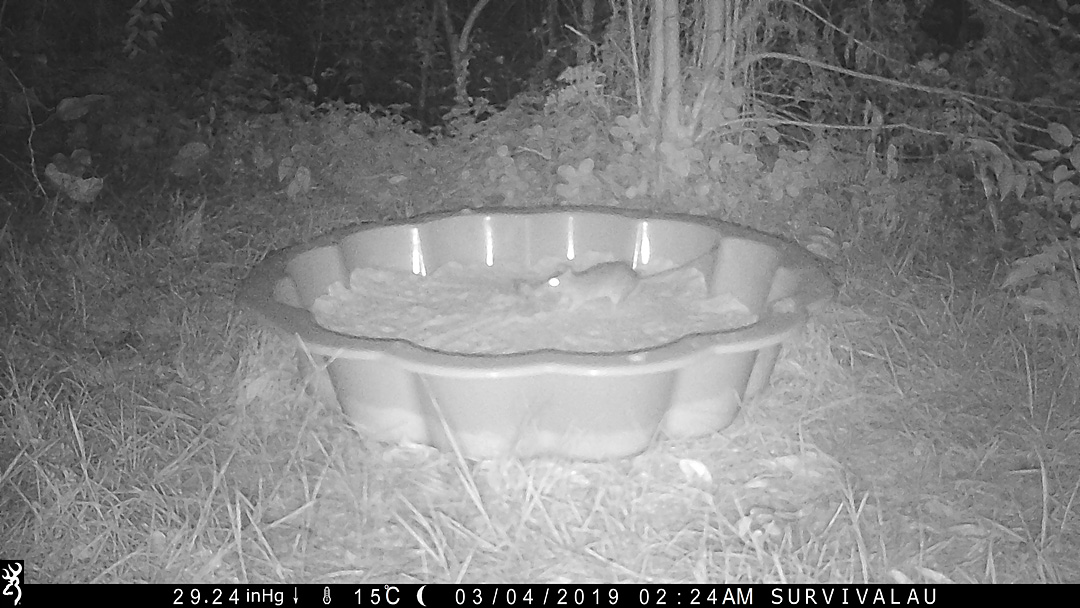
The trail camera uses a motion detecting sensor and takes photos whenever something moves in front of it. You can read more here about the trail camera on the trail camera web page. It has an invisible infrared flash, so it can invisibly take pictures in complete darkness. These are black and white (since the infrared illumination does not show the colours of anything). When there's enough daylight to not need the flash, the trail camera takes colour photos. It was set to take one picture every five seconds, whenever something was moving in front of it. By the time I went back to look at the camera, it had taken 660 photos. Some of the photos were just of blades of grass waving in the wind, in front of the motion detecting sensor. This seemed to happen much more in the daytime than during the night. The second time I set it up, I was very careful to pull out all long blades of grass or other weeds which may have blown around in the wind in front of the trail camera. Also, the alignment of the tracking box in front of the camera was not perfect. This trail camera does not have an LCD screen that allows you to see the photos on the camera. If you have a camera with that feature, you could do a test photo to point the camera properly in front of the tracking box. This is the first photo at night that set off the motion detector. And fortunately, it wasn't just the wind and the grass:
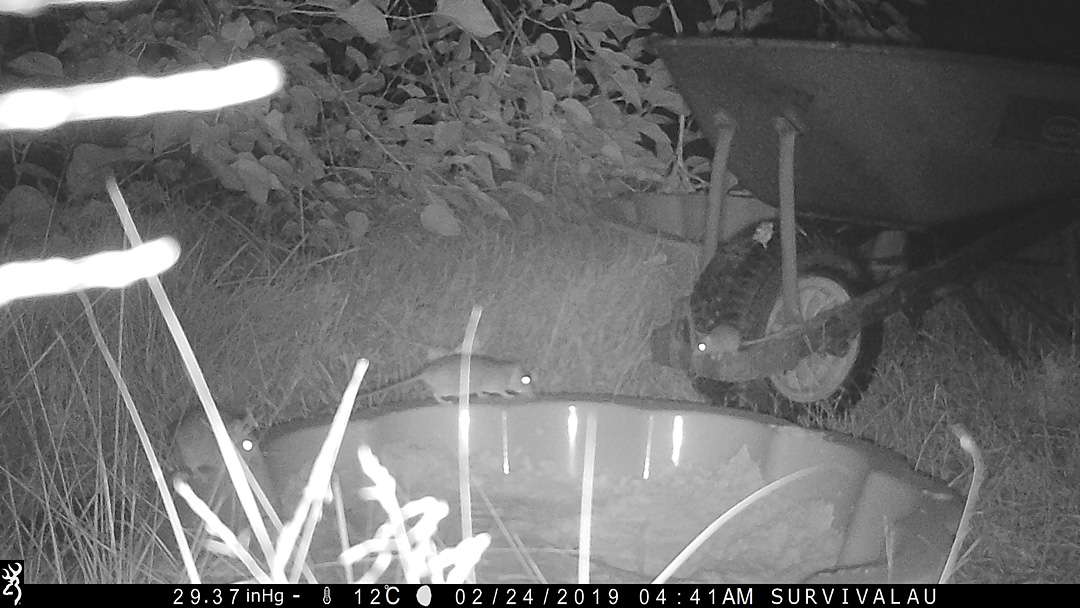
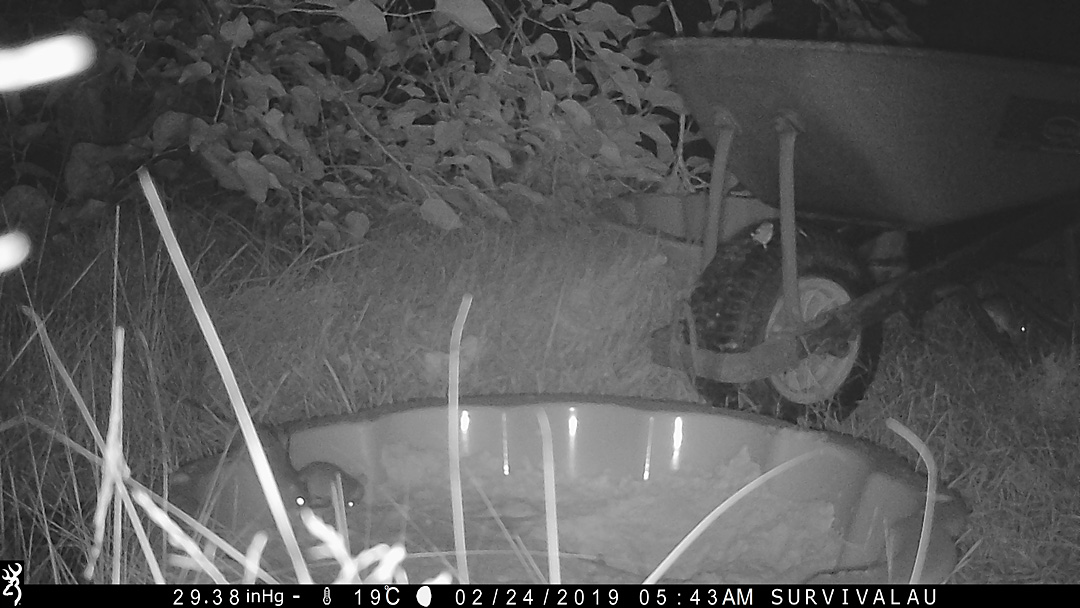
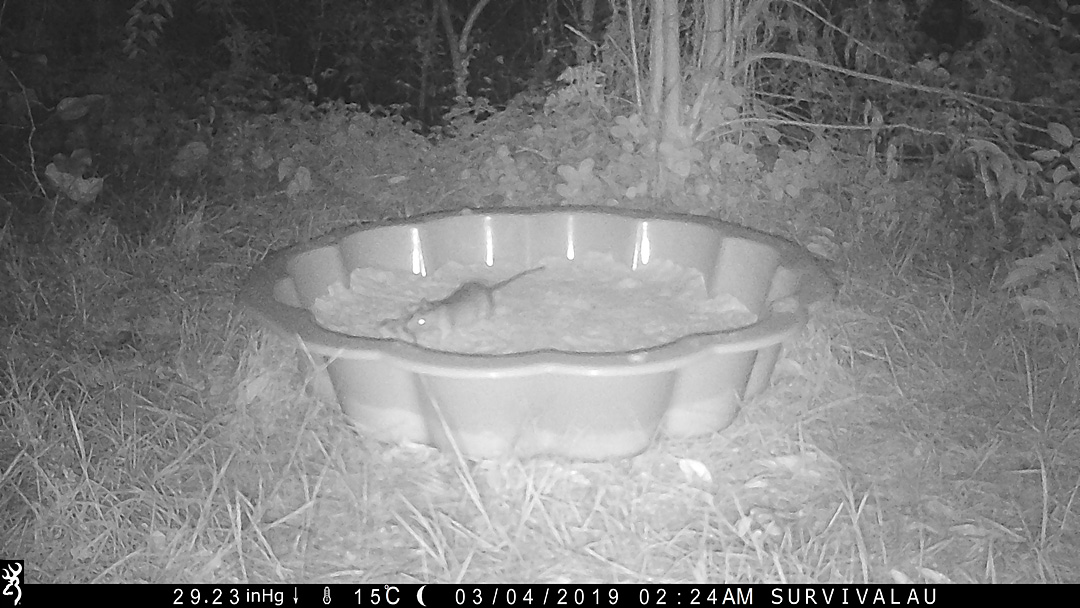
There were 152 photos taken in this series, all of rats, between the hours of 8:50 pm and 5:52 am. This is very interesting information if you're learning about what animals are prowling around your local vicinity at night, and at what times they are out and about. Here's a couple more from this series. The most rats photographed at any one time was three.
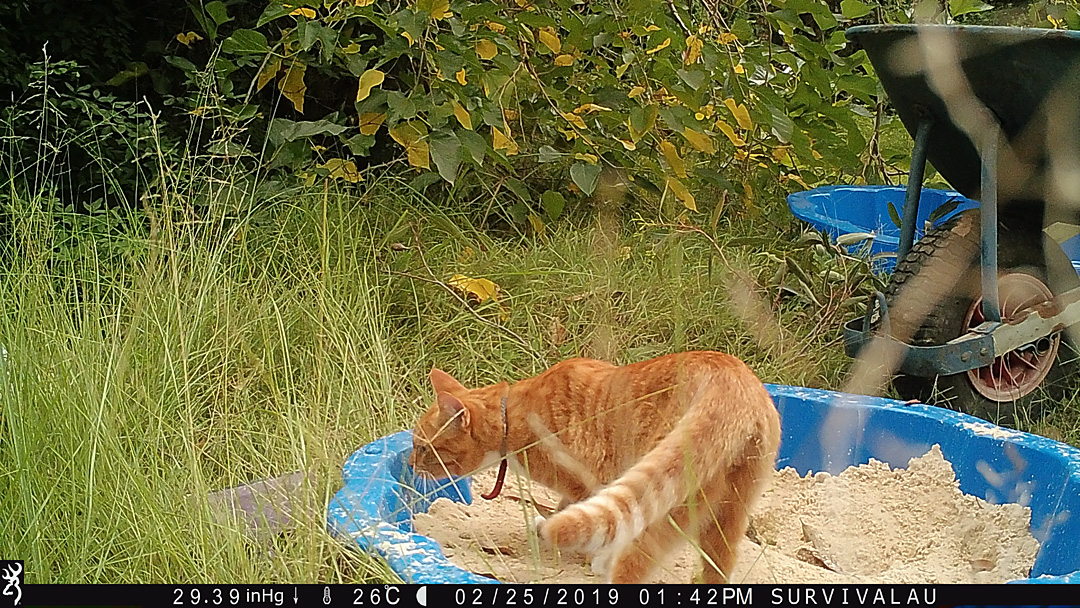
In the daytime this cat was captured by the trail camera. So it's now completely clear what made the larger tracks in the track photos near the top of this web page.
I left it set up like that for a few nights before checking the camera. Out of the 660 photos there were many of the rats, a few of the cat, and quite a few of just the blades of grass blowing in the wind in front of the motion sensor. Second Setup of the Tracking Box and Trail CameraThis is the setup I used the second time. The tracking box was moved closer to the rear boundary of my property, in hope that a fox would come (it was the exact same place I photographed a fox before).
This time there were 348 photos taken over two nights. The camera can also take video but you have to choose one or the other, and I had it set for still photos so I could use them on this web page. All of these photos were at night, and showed four different types of animal: For this second setup, I took extra care to try to point the trail camera so the tracking box would be right in the middle of its field of view. Unlike the first setup, I got it perfectly correct this time.
There were four photos of this orb-weaving spider, weaving a web in front of the motion sensor, right in the corner of its range of detection.
The rats were there again. This time there were only two of them, but they went into the box much more than the first times. Based on the foot size, it would have definitely been a rat that made the track I analysed with a ruler earlier on this web page. The rats dragged around the meat quite a bit. After the first time I set up the box, and saw the meat had been moved, I thought a larger animal must have moved it than rats.
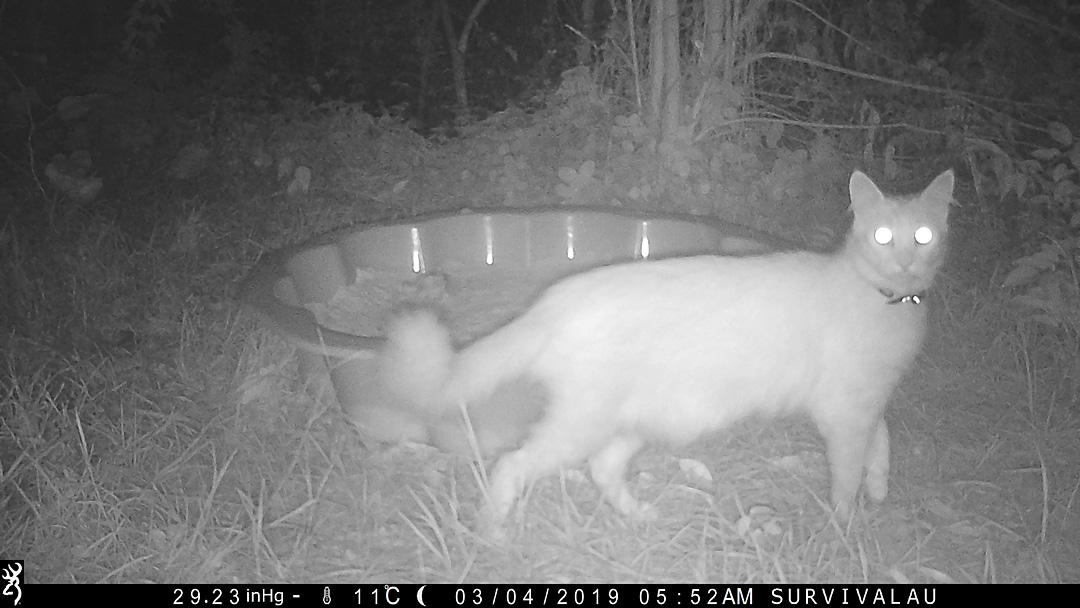
And a cat also visited, this time in the night:
When Not Using Your Tracking Box
|
|
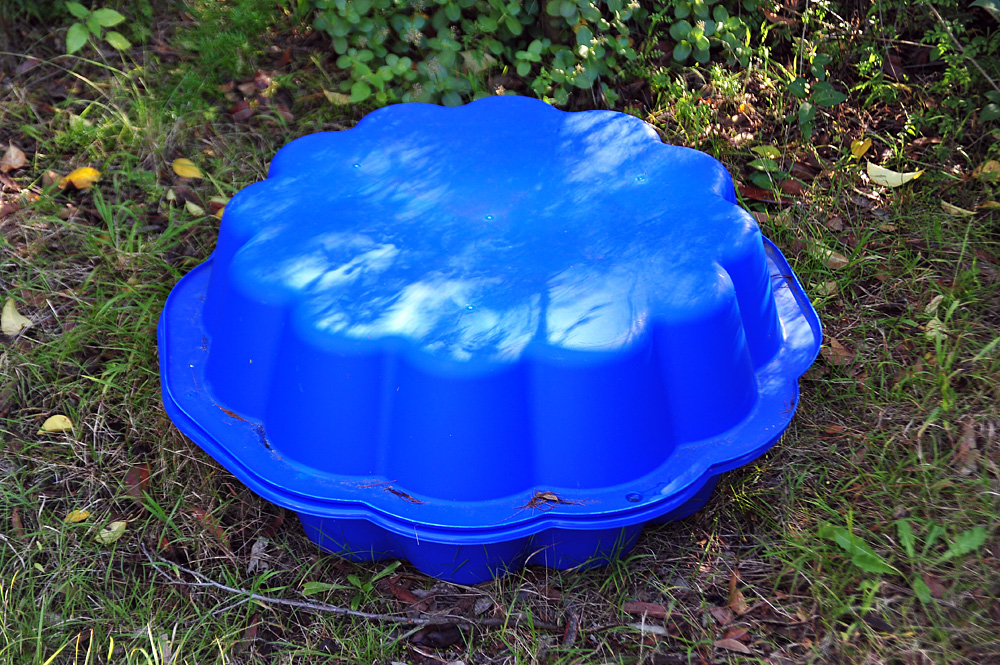
Clam-shell sandpit tracking box with the lid closed (like a real clam). High Resolution 2000 x 1331. |
Recommended Reading
|
Purchase from Australia (Booktopia) |
|
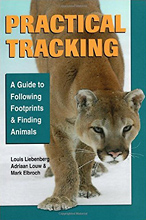
Techniques from international tracking experts applicable to any quarry and terrain. How to follow and find elk, deer, bears, cougars, lions, elephants, leopards, rhinos, cape buffalo, and more. Finding and identifying tracks and sign of an animal's passing is only part of the ultimate goal for serious trackers, hunters, and outdoorspeople. They want to follow the trail to reach the animal in question. This detailed guide teaches them how. Written by a trio of master trackers, it covers what to look for to discern an animal's pathway, what information tracks and sign convey, how to move through the wilderness to get in sight of the quarry, how to avoid dangerous encounters, and more. Click here to purchase from Australia (Booktopia) Click here to purchase from Australia (Fishpond) |
Recommended Listening
|
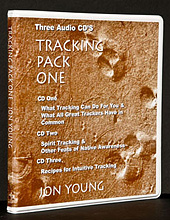
CD1: What Tracking Can Do For You & What All Great Trackers Have In Common CD3: Recipes for Intuitive Tracking Learn how to increase your own 'spirit tracking' and instinctive abilities through stories of cultures and situations that produce the world's finest trackers. Purchase from Wilderness Awareness School (USA) $36.95 US (Possibly North American Sales Only) Purchase from Amazon (Possibly North American Sales Only) |
See Also
Tracking Animals – How To Read Animal Tracks
Tracking Quiz
Using a Trail Camera to Practice Trapping and/or Study Animals
Survival and Wilderness Skills Books
Return to Site Map
above animal animals australia box camera cat clam close front high learn meat night page photo photos rats resolution sand sandpit second seeing setup track tracking tracks trail
Content is copyright © Survival.org.au 2005-2025 All Rights Reserved. Terms of Use. Definitely read the disclaimer before trying anything from this website, especially including the practices and skills. This website uses affiliate links – this doesn't cost you any more, but I get a commission on purchases made through the website. As an Amazon Associate I earn similarly from qualifying purchases.